Should You Join a Startup?
Clarity before chaos: how to know if a startup is right for you right now.

Startups promise excitement, autonomy, and impact. And they often deliver. But they also come with ambiguity, pressure, and sometimes disappointment.
With widespread tech layoffs, a sense of urgency around accepting offers, the AI startup hype, and economic uncertainty, the startup decision has never been more complex. This landscape makes it tempting to either grab the first startup role available or chase the hottest AI company without considering whether it actually fits your goals, work style, and life circumstances. Both approaches often lead to predictable disappointment.
I get asked about startups versus big tech often, especially from people early in their careers or planning a transition. The questions are always some version of: Should I take the startup offer? Is it worth the risk? How do I know if it's right for me?
I've been in early-stage startups that fizzled fast, and others that dragged on longer than they should have. I've also worked in successful startups, big tech, and academic spaces. Looking back, I made predictable mistakes: I got swept up in vision over market reality, didn't ask founders the hard questions, and accepted unsustainable work demands that cost me personally. Each environment taught me something I couldn't have learned elsewhere about culture, companies and about how to evaluate opportunities before they evaluate me.
This guide isn't here to glorify startup life or scare you off. It's here to help you decide, with clarity, whether a startup is the right next step for you right now.
What Are You Actually Optimizing For?
Before you get seduced by equity percentages or impressed by pitch decks, pause. What's your real priority in this season of your life?
Are you optimizing for growth, or stability? For speed, or depth? For impact, or alignment?
These aren't abstract questions. Your answers determine whether a startup's inherent tradeoffs will energize you or exhaust you.
Financial reality check: Can you absorb a lower salary for equity that might never materialize? Do you have enough runway to weather potential delays in funding or revenue?
Work style assessment: Do you thrive when everything's changing, or do you need some foundational structure to do your best work?
Risk tolerance: How much uncertainty can you handle right now in both your professional and personal life?
The clarity you develop here becomes your filter for every conversation that follows. Without it, you'll find yourself reacting to opportunities rather than choosing strategically.
The Myth vs. Reality Matrix
Let's get honest about what startup life actually looks like:
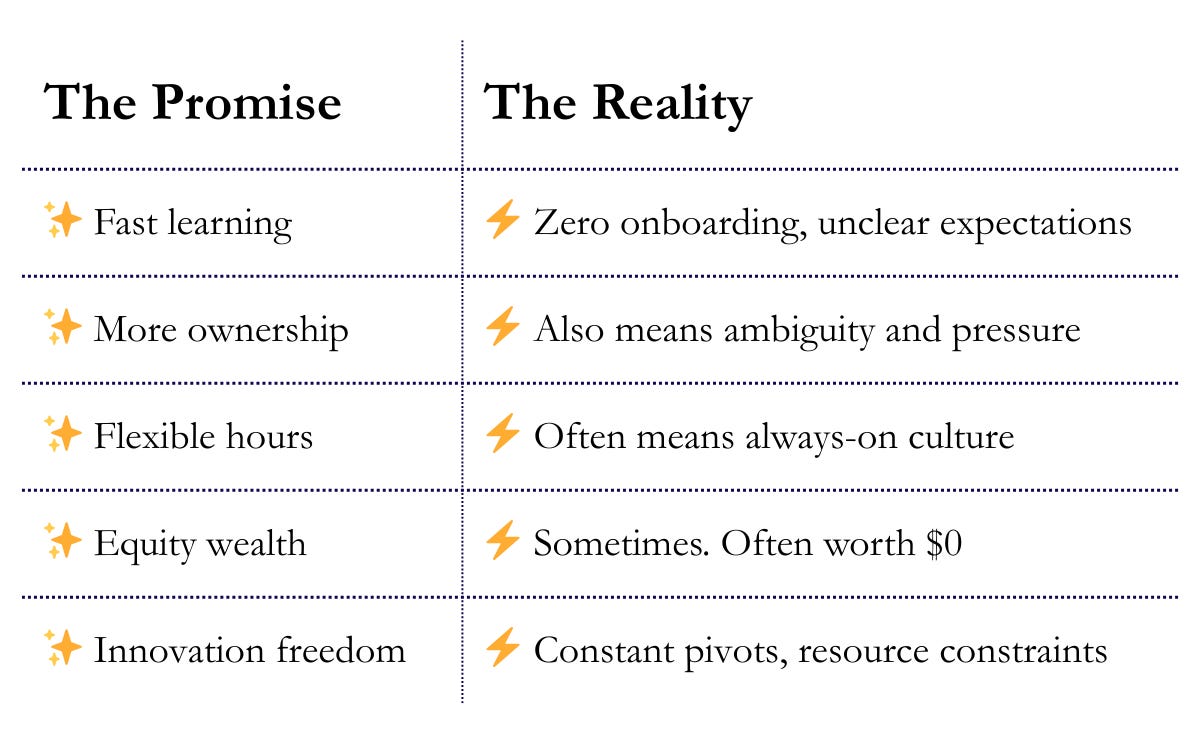
To be very clear, these aren't red flags. They're tradeoffs. And tradeoffs are fine, if you know you're making them consciously.
The problem isn't that startups are hard. It's that we often say yes without understanding what we're actually signing up for.
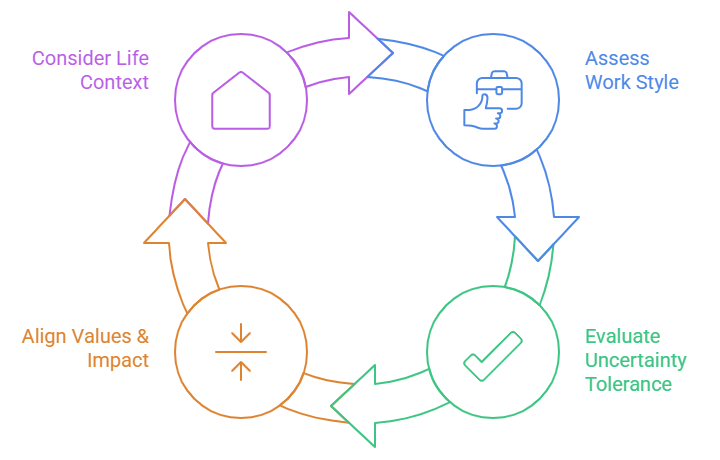
Fit Factors That Actually Matter
Forget the generic advice about "passion" and "risk tolerance." These questions cut through the noise. Here's how they play out in practice:
Note: The following examples are for illustrative purposes and are drawn from both real experiences and composite scenarios to protect individual privacy.
Your work style:
Do you get energized by building while everything's shifting around you?
Can you create your own structure when none exists?
Do you need clear role boundaries, or do you prefer fluid responsibilities?
Sarah thrived at her 15-person startup precisely because there were no established processes. Coming from a rigid enterprise environment, she loved creating documentation systems, establishing team workflows, and defining engineering practices from scratch. Two years later, she became head of engineering operations.David struggled with the same lack of structure at his startup. Despite being excited about the product, he found himself constantly anxious about unclear expectations, inconsistent code review processes, and shifting priorities. After eight months, he left with the realization that he performed better with some foundational systems already in place.Your relationship with uncertainty:
Can you make decisions with incomplete information?
Are you comfortable with frequent changes in product direction, team composition, even leadership?
Do you see ambiguity as creative opportunity or anxiety-inducing chaos?
When James's AI startup pivoted from consumer to enterprise markets, he saw it as an exciting puzzle. The technical challenges of adapting existing systems for entirely new use cases energized him. He enjoyed the strategic thinking required and felt proud when his architectural decisions enabled the successful transition.Mike had a different experience with his company's pivot from social media management to creator economy tools. Despite being technically capable, he found himself stressed about whether his work would last more than a few months. The uncertainty made it difficult for him to invest deeply in solutions, knowing they might be scrapped.Your values and impact needs:
Do you genuinely believe in this specific mission, or are you attracted to the idea of "making a difference"?
Do you need to see how your work directly touches customers?
How important is it that your colleagues share your values?
Lisa joined a healthcare startup focused on mental health accessibility and stayed motivated even during difficult periods. Long hours, funding uncertainty, and technical challenges felt manageable because she regularly received messages from users whose lives had been improved by the platform. The mission alignment sustained her through startup volatility.Mark left a "socially conscious" e-commerce platform after discovering the founders prioritized unicorn status over their stated environmental mission. Building features designed to maximize engagement rather than sustainable shopping felt like a daily compromise of his values.Your life context:
Are you in a season where you can prioritize professional growth over predictability?
Can you maintain your own boundaries in a "move fast and break things" environment?
What does your support system look like if work becomes all-consuming?
Parker joined a startup with minimal financial obligations and strong family support nearby. The 60-hour weeks and weekend launches felt like an adventure. They learned rapidly, built strong relationships with the early team, and their equity provided a significant payout when the company was acquired.Alex tried a similar experience, now married with a toddler and mortgage payments. The startup intensity that once energized him now created unsustainable stress. Missing family dinners and worrying about financial uncertainty made him realize this life stage required different choices about risk and work-life integration.When the Answer Is No (And Why That's Wisdom)
Not every startup offer deserves your yes, no matter how compelling the pitch deck or impressive the founding team.
Pay attention if you feel rushed to decide, confused about the actual role, or like you're "supposed" to want this opportunity but something feels off. That's not imposter syndrome. That's discernment.
I've watched brilliant people take startup roles that were objectively good opportunities but wrong for them at that moment. The cost isn't just professional; it's personal. When the fit is wrong, you don't just leave a job. You often leave questioning your own judgment.
Saying no to the misaligned opportunity creates space for the right one. It's not career limiting. It's career protecting.
Your Decision Framework
Here's what to do when you're evaluating a startup opportunity
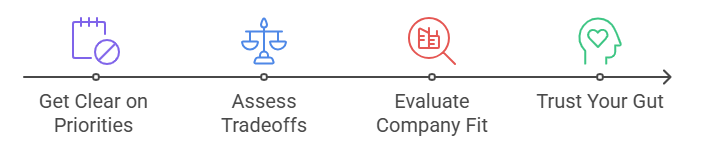
Step 1: Get clear on your optimization priorities. Write them down. Rank them. Be honest about what matters most right now, not what you think should matter.
Step 2: Assess the actual tradeoffs. What will you gain? What will you give up? Are you willing to make those specific exchanges?
Step 3: Evaluate the company through your lens. Does their culture, stage, and approach align with how you work best?
Step 4: Trust your gut. If it feels forced or you're trying to talk yourself into it, pause. The right opportunity will feel challenging but not confusing.
Making This Practical: The Startup Fit Assessment
Self-awareness without application remains abstract. To translate these insights into decision-making power, you need structured reflection on what actually matters to you.
The Startup Fit Worksheet helps you systematically evaluate your preferences across five key areas: values and mission alignment, role and career growth priorities, lifestyle and work environment needs, team and culture fit, and compensation and financial goals.
The assessment takes 1-3 hours if you're new to startup thinking, or 30-60 minutes if you've reflected on these topics before. Many people find it helpful to complete sections over several days, letting insights develop between sessions.
The process includes:
Preference scoring across key decision factors
Scenario testing to see how you react to realistic startup situations
Stage compatibility analysis to understand whether seed, Series A, or Series B aligns with your goals
Red flag identification based on your specific priorities
Decision-making preparation so you can evaluate actual offers systematically
Most importantly, the worksheet forces you to confront common misconceptions about what you think you want versus what you actually enjoy in practice. Many people discover they want equity over salary in theory but can't afford the trade-off in reality, or that they're attracted to "wearing many hats" but struggle with constant context switching.
The goal is understanding yourself well enough to recognize when an opportunity aligns with who you are and what you need right now.
📥 Download the complete Startup Fit Worksheet to work through these questions systematically before your next startup conversation.
What This Clarity Gets You
When you're clear on your priorities and preferences, startup conversations become more productive. You'll ask better questions, recognize misalignment faster, and feel confident in your decisions regardless of outcome.
You'll stop trying to convince yourself that every interesting opportunity is right for you. You'll start recognizing which specific opportunities deserve serious consideration.
Ask yourself: What am I optimizing for in this season of my life?
Your answer might surprise you. And that clarity, not the startup itself, is what will guide you toward work that actually fits.
The chances are good that if this resonated, you're ready to move beyond generic career advice toward the specific realities of different startup stages. Understanding what you'll actually be doing day-to-day at a seed company versus Series A versus Series B helps you match your preferences to the right opportunity.
But first, do the work of getting clear on what you want. Everything else builds from there.
What's your biggest question about evaluating startup opportunities? The chances are good that someone else is wondering the same thing.